PR review
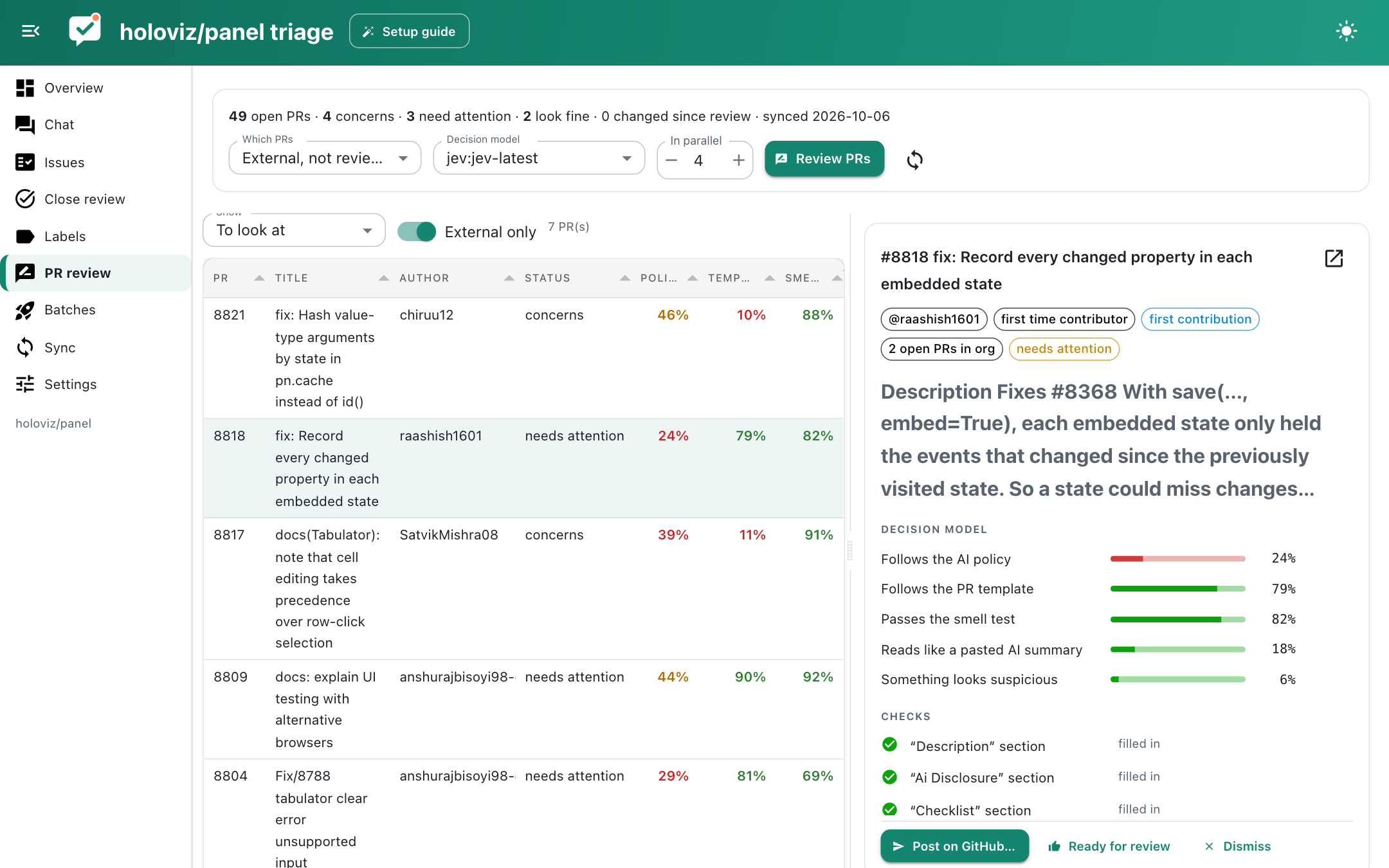
PR review is a first pass over open pull requests that answers three questions before a maintainer spends time on a PR: does the description conform to our AI policy, does it follow the PR template, and do the changes pass a smell test.
What is checked
Automatic checks compare the description with the PR template and the policy:
- every template section is present and filled in, not left as the placeholder; sections the template says may be deleted (such as an AI disclosure when no AI was used) can be removed;
- placeholders such as
{issue}were replaced and the checklist is ticked; - the AI disclosure, if kept, names the tool and model;
- an issue is linked with "Fixes #N";
- screenshots or a recording are included when frontend files changed;
- code changes come with test changes;
- the author has at most
max_openopen PRs across the organisation; - the description is not mostly a bullet list of changes.
Decision model questions, each answered with a probability, given the description, the template, the policy, the automatic checks and an excerpt of the diff:
| Question | Good when |
|---|---|
| Follows the AI policy | high |
| Follows the PR template | high |
| Passes the smell test: focused, consistent with the issue, idiomatic, tested | high |
| Reads like a pasted AI summary | low |
| Something looks suspicious: obfuscated code, network calls, unrelated CI or packaging changes | low |
Each PR ends up as looks fine, needs attention (one failed check or score) or concerns (several, or anything suspicious). Bots such as Dependabot and pre-commit.ci are skipped, and by default so are maintainers (trusted author associations), though you can include them.
Policy and template
The policy is a markdown file in the workspace, prs/policy.md by default; put your project's contribution or AI usage rules there. The template is found automatically in the repository's .github folder or the organisation's .github repository, or you can point template at a file.
[prs]
policy = "prs/policy.md"
template = ""                 # empty: the repository's or organisation's pull_request_template.md
max_open = 2
threshold = 0.5
trusted = ["OWNER", "MEMBER", "COLLABORATOR"]
model = ""                    # default: [agents] decision_model
explain_model = "openrouter:openai/gpt-6-luna"
Acting on results
Reviews run as a background job, so they continue if you close the page; results appear as they come in.
For each PR the detail pane shows the issues it says it fixes (with their triage verdict and a link to the Issues page), the scores, every check with its outcome, the changed files and a comment box. Draft comment asks an LLM to write a short, friendly comment that lists only what is missing; pick the model under Draft with (it defaults to explain_model), and the pane notes which model drafted it. Stage comment queues it in the Outbox and moves on; Ready for review and Dismiss record your decision locally. When new commits are pushed the PR shows as changed since review and is picked up again by the next "not reviewed" run.
./triage.py prs sync
./triage.py prs review --scope external --limit 20
./triage.py prs review 8821
./triage.py prs list
./triage.py prs comment 8821      # draft a comment; stage it in the app, send it from the outbox
PR descriptions and diffs are untrusted input too. They only reach models as data to judge, and the models used here have no tools.